Studies are finding that a single course of antibiotics alters the gut microbiomes of healthy volunteers—and that it can take months or even years to recover the original species composition.
The development of antibiotics was a breakthrough in medicine. But while they can save lives, they have a dark side. Microbes resistant to the drugs were responsible for more than one million deaths in 2019, according to a study published earlier this year in The Lancet.
Furthermore, a growing number of studies are finding that even a short course of antibiotics can alter the makeup of the bacterial species in the gut. These community changes can be profound, with some people’s microbiomes taxonomically resembling those of critically ill ICU patients after taking the drugs. And the microbes that survive the treatment tend to carry resistance genes, potentially enabling pathogens to acquire the means to evade our best pharmacological weapons.
Overall, Washington University School of Medicine in St. Louis pathologist and microbiologist Gautam Dantas says that the findings are a warning that “taking antimicrobials is a gamble every single time you do it, even if it’s fully warranted.”
Probing healthy microbiomes
One of the tricky aspects of studying the effects of antibiotics is that the gut microbiomes of patients prescribed them are “already in disarray for other reasons,” says Dantas, especially among people who have been hospitalized. In such cases, it may be difficult to separate the antibiotic’s effects on the microbiome from illness-related alterations. So researchers—including Dantas and his colleague, infectious disease specialist Jennie Kwon—have been turning to healthy volunteers.
“A lot of people prescribe [antibiotics] thinking that there’s very little harm, especially if it’s just an oral pill for a couple of days,” says Kwon. “Our question was, is that true? When you give a healthy person a short course of antibiotics, does that cause any disruption to the gut microbiome?”
The team recruited 20 healthy volunteers and divided them into four groups, each of which received a different antibiotic or combination of antibiotics for five days. The drugs chosen—levofloxacin, azithromycin, cefpodoxime, and a combination of azithromycin and cefpodoxime—are often given to patients with community-acquired pneumonia, even though the condition is sometimes viral. Fecal samples were collected and analyzed before, during, and after the antibiotics course, with the last sample taken six months post-treatment. From these samples, the researchers charted how the taxonomic diversity of bacteria in the gut changed and any fluctuations to the copy number of resistance genes.
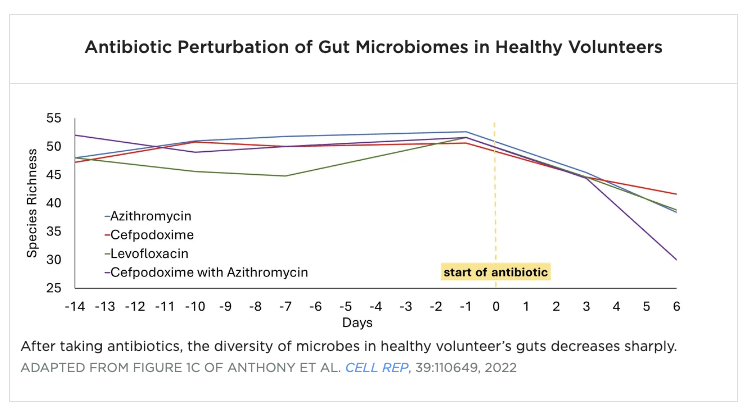
Immediately after taking antibiotics, the total and culturable species richness decreased, the team found. For most of the volunteers, these measures returned to baseline values after two months—but the species present remained changed, notes Winston Anthony, a PhD candidate at Washington University School of Medicine in St. Louis who co authored the Cell Reports paper the team published last month announcing the results. This means antibiotics “are fundamentally restructuring the microbiome,” he says.
In three of the healthy volunteers, who were assigned to different treatment groups, the gut microbiome was especially perturbed. They continued to have reduced microbiome diversity even at the end of the six months. “Their gut microbiome became more similar to that of an ICU patient than of a healthy individual,” says Kwon. Still, she noted that they and the other participants felt fine.
W. Joost Wiersinga, an infectious disease specialist at the University of Amsterdam who has separately studied the effects of antibiotics in healthy people, tells The Scientist the new work “adds to the evidence that antibiotics can have major detrimental effects on the gut microbiome in healthy adults.”
Indeed, in the 2018 study conducted by Wiersinga and colleagues, healthy volunteers who took a one-week course of broad-spectrum antibiotics experienced a drop in gut microbiome diversity and an overgrowth of Streptococcus and Lactobacillus genera. Although these bacteria became less abundant over time the participants’ microbiome composition remained different from its initial state for the duration of the study, which was up to 31 months after taking antibiotics.
“Antibiotic scarring” may have lasting impact on resistance
In addition to inducing compositional changes to the microbiome, antibiotics seem to increase the prevalence of resistance genes. In Anthony et al.’s study, for three of the four antibiotics (all but levofloxacin), there were higher relative numbers of antibiotic resistance genes in the samples taken six months after treatment—a change the authors call “antibiotic scarring.”
This long-term increase in resistance genes is a notable insight for Francisco Guarner, a digestive system researcher at the University Hospital Vall d’Hebron in Barcelona who was not involved in the study. He describes the gut microbiome as an ecosystem that is perturbed by antibiotics. “When you take antibiotics, some bacteria in the network disappear [and] the others overgrow, so the balance is different. In this new balance, what you gain are bacteria that are more resistant to antibiotics.”
Gut bacteria that harbor antibiotic resistance genes may pose several threats. When gut bacteria and pathogens mingle, the resistance genes can be transferred, allowing pathogens to acquire resistance. One recently published study observed that resistant gut commensals can even degrade antibiotics in the gut, shielding pathogens from the effects of the drugs.
In further research, Kwon is investigating whether some healthy people in the community may serve as reservoirs for resistance genes, which could potentially be passed to others.
Why do some people’s microbiomes respond differently to antibiotics?
It’s not yet clear why some people’s gut microbes seem to be especially disrupted by antibiotics. “There is a lot of variation between individuals,” Wiersinga notes, in whether people’s microbiomes recover to their initial states, and if so, how long that takes.
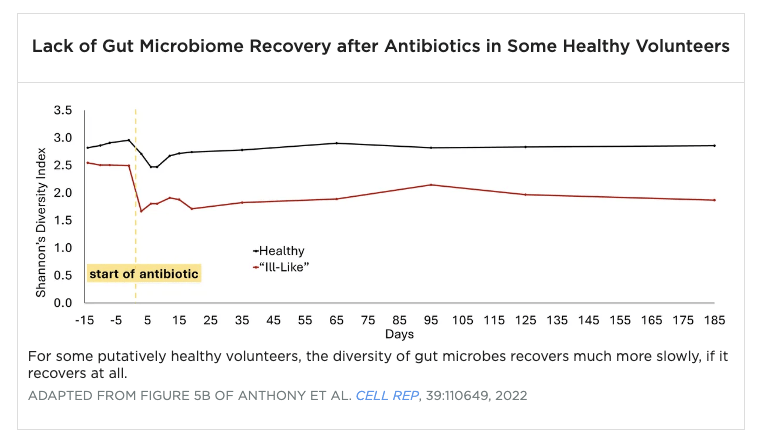
The state of the microbiome before treatment may play a factor in that, Anthony notes. In his study with Dantas and Kwon, the three volunteers whose gut microbiomes came to resemble those of ICU patients started out with slightly lower species diversity. Anthony puts forward several hypotheses to explain this initial difference, including that they may have had rounds of antibiotics before the study. Discerning the cause of differential responses to antibiotics could help refine their use, Kwon says, though future studies will need to uncover the microbial and metabolomic factors involved and determine whether they have predictive clinical value.
Ultimately, Wiersinga sees the accumulating findings as a reminder for doctors to “think twice when we prescribe antibiotics: does my patient really need it?”
Source: https://www.the-scientist.com/news-opinion/what-happens-to-the-gut-microbiome-after-taking-antibiotics-69970


